
Deploy the server
Each organisation runs one Docker Compose stack: kestrel-server (console and REST API on port 443, agent gRPC with mutual TLS on port 8443), PostgreSQL 16 (control plane) and ClickHouse (telemetry). All data stays on your host.
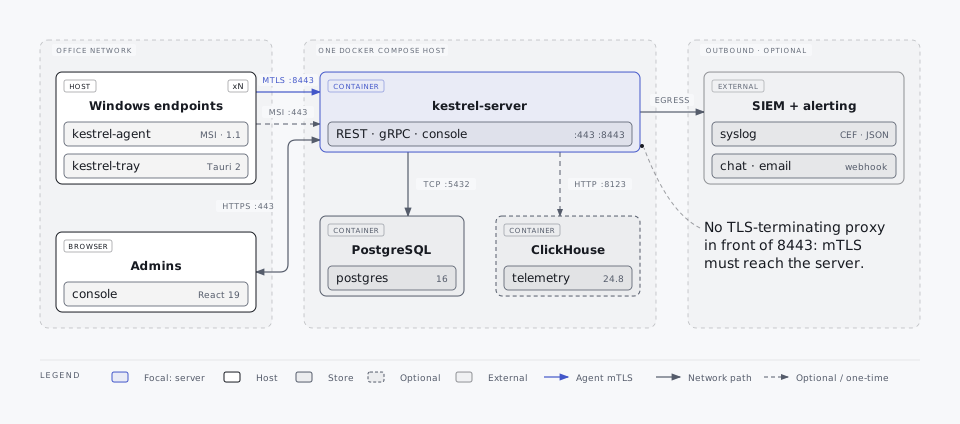
Install
git clone https://github.com/lawbyte/kestrel-edr.git && cd kestrel-edr/deploy
cp .env.example .env
sed -i "s|^KESTREL_MASTER_KEY=.*|KESTREL_MASTER_KEY=$(openssl rand -base64 32)|" .env
$EDITOR .env        # KESTREL_PUBLIC_HOSTNAME, POSTGRES_PASSWORD, CLICKHOUSE_PASSWORD
docker compose up -d --build
Then open https://<KESTREL_PUBLIC_HOSTNAME>/ and complete first-run setup: the one-time setup code (from docker compose logs kestrel-server | grep "SETUP CODE", or the value of KESTREL_SETUP_CODE), the organisation name and the first administrator.
Check health:
docker compose ps                                       # every service "healthy"
curl -k https://localhost/api/auth/setup-status
curl -k https://localhost/api/healthz                   # unauthenticated health endpoint
Small sites without ClickHouse
Set CLICKHOUSE_URL= (empty) in .env. Telemetry then goes to PostgreSQL with at most 7 days of retention. Start only the two services you need, and remove the clickhouse entry from depends_on of kestrel-server in docker-compose.yml:
docker compose up -d postgres kestrel-serverConfiguration (.env)
All variables below exist in deploy/.env.example or are read by the server.
| Variable | Default | Meaning |
|---|---|---|
KESTREL_MASTER_KEY | (empty, required) | Wraps the agent CA key, the self-signed web key, TOTP secrets and notification secrets (AES-256-GCM). Generate once with openssl rand -base64 32. Back it up separately from the database. Losing it means a new CA, and every agent must re-enroll. |
KESTREL_PUBLIC_HOSTNAME | edr.example.internal | DNS names (or IPs) that agents and browsers use, comma separated. They become the SANs of the agent gRPC certificate (regenerated at every start) and of the self-signed web certificate. The first name is the primary one: installer scripts and install commands use it, so it must be reachable from every endpoint. |
KESTREL_HTTPS_PORT | 443 | Host port published for the console, REST API and downloads. |
KESTREL_GRPC_PORT | 8443 | Host port published for agent gRPC. |
KESTREL_GRPC_PUBLIC_PORT | 8443 | Port agents dial, if NAT or a load balancer changes it. Used in install commands. |
KESTREL_HTTPS_PUBLIC_PORT | KESTREL_HTTPS_PORT | Port browsers and generated installers use for the console and /downloads, if NAT or a proxy changes it. |
POSTGRES_USER, POSTGRES_PASSWORD, POSTGRES_DB | kestrel, (required), kestrel | PostgreSQL credentials. DATABASE_URL overrides the composed connection string. |
CLICKHOUSE_URL | http://clickhouse:8123 | ClickHouse endpoint. Empty = PostgreSQL fallback for telemetry. |
CLICKHOUSE_USER, CLICKHOUSE_PASSWORD, CLICKHOUSE_DB | kestrel, (required), kestrel | ClickHouse credentials. |
TLS_CERT, TLS_KEY | unset | PEM paths of your own web certificate, mounted from deploy/tls/ (for example /app/tls/fullchain.pem, /app/tls/privkey.pem). Unset = self-signed. |
KESTREL_AGENT_MSI_URL | unset | External MSI URL. Default: https://<host>/downloads/KestrelAgent.msi from deploy/installers/. |
KESTREL_HEARTBEAT_INTERVAL_SECS | 60 | Expected agent heartbeat. More than 3 missed intervals on a live stream raise TP-SRV-HEARTBEAT. |
KESTREL_TRUSTED_PROXIES | (empty) | IPs or CIDRs of your reverse proxies. X-Forwarded-For is honoured only from these addresses (right-most untrusted hop), for login throttling and audit. Empty = the TCP peer address is used. |
KESTREL_SETUP_CODE | unset | One-time code for the first-run setup screen. Unset = a random code is printed in the server log at startup until the first administrator exists. |
KESTREL_OUTBOUND_ALLOW_CIDRS | unset | Private ranges that webhooks, Slack, Teams and the OIDC issuer may reach (for example an internal Keycloak). By default outbound HTTP reaches only public addresses, never follows redirects and never reaches link-local or cloud-metadata addresses. |
KESTREL_UPDATE_PUBKEY | unset | Base64 Ed25519 public key for signed agent updates. Without it, registering a release in the console is refused. See Agent updates. |
BUILD_CONSOLE | 1 | 0 builds an API-only image without the console. |
KESTREL_IMAGE_TAG | local | Tag of the built kestrel-server image. |
RUST_LOG | info,sqlx=warn | Log filter. |
KESTREL_LOG_FORMAT | text | json for structured logs for your log shipper. |
Retention, notifications (email, Slack, Teams, signed webhook, syslog), OIDC single sign-on and the MFA requirement are set in the console under Settings and stored in PostgreSQL.
To run the server outside Docker, also set KESTREL_HTTPS_ADDR and KESTREL_GRPC_ADDR (bind addresses; defaults 0.0.0.0:443 and 0.0.0.0:8443), CONSOLE_DIR (the built console) and AGENT_DIR (the folder with KestrelAgent.msi). The master key must be at least 16 characters.
Ports and firewall
| Port | Who connects | Purpose |
|---|---|---|
| 443/tcp | Admin browsers; endpoints (MSI download only) | Console, REST API /api, /downloads |
| 8443/tcp | Endpoints | Agent gRPC with mutual TLS; also signed update packages under /downloads/updates/ |
Restrict 443 to the networks your administrators use. Endpoints need 8443 (and 443 only to download the MSI). Do not put a TLS-terminating proxy in front of 8443: mutual TLS must reach the server. Use TCP pass-through if you need a proxy.
TLS
Console (443). Without TLS_CERT and TLS_KEY, the server creates a self-signed certificate on first run. It is stored encrypted and regenerated only when KESTREL_PUBLIC_HOSTNAME changes. For production, use a certificate from your internal PKI or an ACME client:
cp fullchain.pem privkey.pem deploy/tls/
# in .env:
#   TLS_CERT=/app/tls/fullchain.pem
#   TLS_KEY=/app/tls/privkey.pem
docker compose up -d
Agents (8443). On first run the server creates an internal agent CA. It signs the gRPC server certificate and one client certificate per device (CN = device id, valid for 1 year). The MSI pins this CA: it is passed base64-encoded as CA_B64= in the install command, and the agent trusts only that CA, never the Windows root store.
Certificate renewal. Agents renew their client certificate over their authenticated stream when fewer than 30 days remain. The old certificate is revoked once the agent connects with the new one. Expired or revoked certificates cannot renew; re-enroll the device with a token. Deleting (decommissioning) a device revokes its certificates and drops its connection immediately.
Publish the agent MSI
Put KestrelAgent.msi (and optionally a VERSION file) in deploy/installers/. The folder is mounted read-only into the container at /app/agent.
- It is served at
https://<host>/downloads/KestrelAgent.msi. - Its SHA-256 appears in
GET /api/agent/installerand on Settings > Enrollment. - Installer scripts (
Install-Kestrel-<profile>.cmd) are generated only when this file exists, because the script pins the MSI's SHA-256.
Signed update packages go into deploy/installers/updates/; see Agent updates.
Backup and restore
Back up three things: the PostgreSQL database, the ClickHouse volume (optional; telemetry only) and .env (it holds the master key).
# Backup (for example a daily cron job)
docker compose exec -T postgres pg_dump -U kestrel -Fc kestrel > kestrel-$(date +%F).dump
docker compose exec -T clickhouse clickhouse-client --user "$CLICKHOUSE_USER" --password "$CLICKHOUSE_PASSWORD" \
  --query "BACKUP DATABASE kestrel TO File('/var/lib/clickhouse/backups/kestrel-$(date +%F)')"   # needs a <backups> config, or snapshot the chdata volume
cp .env /secure/offline/location/kestrel.env

# Restore
docker compose up -d postgres
docker compose exec -T postgres pg_restore -U kestrel -d kestrel --clean --if-exists < kestrel-YYYY-MM-DD.dump
docker compose up -d
The restored server must use the same KESTREL_MASTER_KEY. Otherwise it refuses to start (cannot decrypt stored secrets). After a restore, verify the hash-chained audit log in Settings > Audit log > Verify (GET /api/audit-log/verify).
Upgrade
git pull
docker compose build kestrel-server
docker compose up -d kestrel-server
Database migrations run automatically at start. They are forward-only, so take a backup first. Connected agents reconnect within seconds and replay anything not yet acknowledged from their local outbox, so nothing is lost during the restart.
Sizing
Planning estimates. Validate them with your own telemetry volume. They assume default telemetry (all event kinds) at roughly 1 to 5 KB/s per busy endpoint and 30-day event retention.
| Endpoints | Host | Disk | Notes |
|---|---|---|---|
| up to 100 | 2 vCPU, 4 GB RAM | 50 to 100 GB SSD | ClickHouse optional; the PostgreSQL fallback (7 days) is fine for a pilot. |
| 1,000 | 4 to 8 vCPU, 16 GB RAM | 0.5 to 1 TB SSD | One host. Give ClickHouse about 8 GB RAM. Consider limiting telemetry event kinds in the policy. |
| 5,000 | 16 vCPU, 64 GB RAM, or split hosts | 2 to 4 TB NVMe | Put ClickHouse on its own host or volume and PostgreSQL on fast SSD. |
Beyond about 5,000 endpoints, a message bus and multiple ingest replicas are needed; that is not implemented yet. ClickHouse stores events with ZSTD compression and a TTL equal to Settings > Branding, privacy & retention > Data retention for events.
Logs and health
- Logs:
docker compose logs -f kestrel-server. SetKESTREL_LOG_FORMAT=jsonfor a log shipper. - Health:
GET /api/healthz(unauthenticated). Compose uses it as the container health check. - Device status in the console:
isolated(the agent reports isolation),offline(no contact for 3 minutes),degraded(ETW unhealthy or events lost in the last hour), otherwiseonline. - Commands queued for offline devices are delivered on reconnect and expire after 7 days.
- Login is rate-limited per source address and per account, with exponential backoff and no hard lockout.
- Every 15 minutes the head of the audit chain is written to the server log (and to syslog when configured), as an external anchor.